
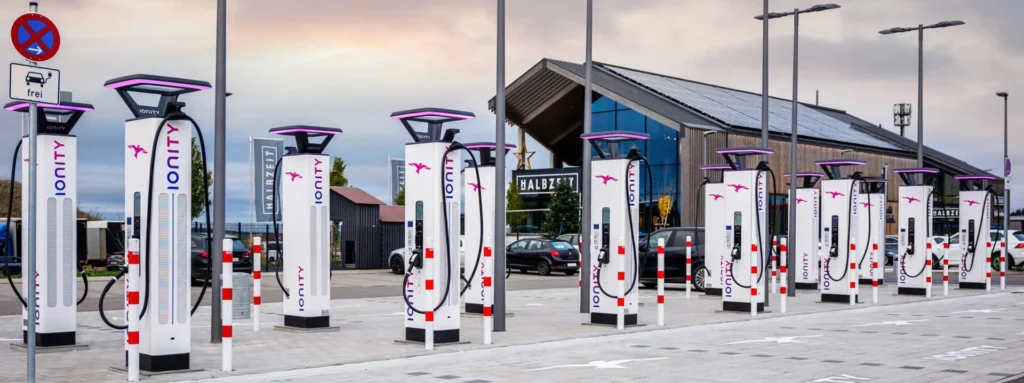

Around electric cars, one idea keeps coming back almost obsessively: “there aren’t enough charging stations.” At first glance, the latest data from Germany seems to directly challenge that perception. And from an automotive perspective, it is safe to say that Germany is the pioneer and often ends up being reflected on the rest of EU. According to BDEW, the public charging network passed the 200,000-point mark by the end of 2025, while the average simultaneous occupancy rate was just 12%. Put simply, that means that, on average, around 88% of public charging points were available at any given time. Bundesnetzagentur, the German federal authority that maintains the public infrastructure register, reported a total of 147,935 AC points and 50,449 fast-charging points as of March 1, 2026, bringing the public network to nearly 200,000 charging points in operation.
It is a powerful statistic. And at the same time, it is exactly the kind of statistic that can be misread. A national average says very little about the real-life experience of a driver on a Tuesday evening, in a crowded neighborhood, after a full day of work, when all they want is to find an available charger a few minutes from home. That is where the real discussion begins. Not with how many charging points exist “in total,” but where they are, when they are useful, and who can genuinely access them. That is precisely why this topic has triggered so much debate: the numbers look good at a macro level, but electric mobility is lived at a local one.
In reality, Germany’s charging network is not weak. Quite the opposite. ADAC describes Germany as having an extensive charging network, concentrated especially along major transport corridors and around large cities. At the same time, the same source points out that density is lower in rural areas. In other words, public infrastructure exists and continues to expand, but it is not distributed perfectly evenly. And that matters enormously. An excellent HPC charger on the motorway is ideal for transit, but it does not solve the problem of the urban driver who has neither a private parking space nor a home wallbox.
This is where the key difference appears: the difference between “enough infrastructure” and the “right infrastructure.” For long-distance travel, Germany is looking increasingly strong. BDEW highlights that the public network has surpassed 200,000 charging points and more than 9 GW of installed capacity, with fast charging making up an increasingly important share of the network. That means shorter charging times on the road and less anxiety on longer trips. But for everyday use, the key factor is not just speed, but proximity. The question is not simply how many chargers a city has, but how many are close to apartment buildings, within neighborhoods, in dense residential areas, and in the places where cars remain parked for hours rather than 20 minutes.
The most relevant figures behind this nuance also come from BDEW. In its January 2026 survey, the organization showed that home charging remains the most common use case. In addition, among users who rely exclusively on public charging, 64% live in multi-family buildings. This may be the single most important detail in the entire debate. The issue is no longer just infrastructure for the “EV driver” in general, but infrastructure for the driver who does not have a private socket of their own. The more adoption shifts from detached homes to urban neighborhoods and apartment buildings, the more pressure moves away from the motorway and into the residential district.
The overall picture is far from pessimistic. The same BDEW data shows that 86% of EV users say their expectations of public charging are being met, while for 58% those expectations are actually exceeded. That suggests the public network, in its current form, is already working reasonably well for a large share of users. In other words, the myth that “there’s nowhere to charge” no longer accurately reflects the broader reality of a mature market such as Germany. But the opposite is not entirely true either: just because the averages look good does not mean every user group is equally well served.
As usual, the truth lies somewhere in the middle. Yes, public charging infrastructure in Germany has expanded faster than demand in recent years. Yes, an average utilization rate of 12% shows that we are not dealing with an overburdened network. But no, that does not automatically mean the challenge of public charging has been permanently solved. What has changed is the nature of the problem. The conversation is no longer primarily about the raw lack of charging stations, but about the quality of their placement, residential coverage, access for those without a wallbox, and the way infrastructure must adapt to a market that is becoming more urban, more diverse, and more mature.
For car enthusiasts and for those following the evolution of electric mobility with a clear eye, the message is straightforward: “88% available” is not proof that chargers were built unnecessarily. It is a sign that infrastructure is finally beginning to move beyond the logic of permanent shortage. That is good news. A healthy network should not have to operate at its limits; it should be robust enough to absorb peaks in demand and support the growth of the EV fleet without bottlenecks. The next phase is no longer just about building more, but about building smarter: closer to homes, closer to real life, closer to where cars sleep, not just where they pass through.
National statistics and day-to-day experience are not the same thing. But when viewed correctly, this is not an anti-EV message. Quite the opposite. It is evidence that the infrastructure debate has entered a more mature phase. We are no longer at the stage where the question was simply, “Are there any chargers?” The real question in 2026 is different: “Are chargers available exactly where people need them?” And the answer, both in Germany and in Romania, seems to be: increasingly yes, but still not evenly enough.